
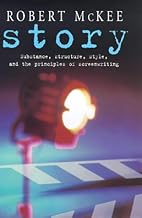
One of the books in the collection is Story: Substance, structure, style, and the principles of screenwriting by Robert McKee. Club member, Michael Alley, below presents a review of this particular book:
Robert McKee’s work almost exclusively encompasses many TV
series but no major films; yet this book and his three-day story writing course
are acclaimed worldwide as the best available, and many well-known films have
been written by attendees at his courses.
The book runs to over 460 pages and it could not, by any means,
be considered as an easy read. It is full of examples of techniques to help one
develop one’s story or progress it when one becomes ‘stuck’. The filmography of quoted examples itself runs
to over 30 pages of two line entries.
“Of the total creative
effort represented in a finished work, 75% or more of a writer’s labor( sic. .
he is an American !) goes into designing (the ?) story. Who are these characters?
What do they want? Why do they want it? How do they go about getting it? What
stops them? What are the consequences?
Finding the answers to these grand questions and shaping them into (a?)
story is our overwhelming creative task.”
The book is divided into four parts each of which has
several chapters: The Writer and the Art of Story; The Elements of Story; The
Principles of Story Design and The Writer at Work.
He sets out 25 different film genres – most of us would
struggle to reach anywhere near that total – then he sets out three levels of
conflict which the main character , or protagonist as he calls her/him will
exhibit and which we need to enunciate and understand in order to know how our
protagonist will react or make decisions at various points in the story – (
heavyweight stuff , this !!) It is the gap between what the protagonist wants
and the achievement he aims for which
involves the three levels of conflict. Many gaps are obvious – Lovers will meet
– a detective will have suspects to identify and so on; and so those gaps won’t surprise the
audience. It is how the gaps are twisted unexpectedly which will grip the
audience and carry it along . [This is
surely a pointer to the editing process – get rid of obvious things which add
nothing to the story?]
McKee points out that many ‘turning points’ (see those set
out by Snyder below) revolve around choices but – if we have developed our
characters properly, there really are no
choices. The choice they will make is so
obvious there is no choice at all. The good guy will do the right thing and the
villain won’t ! It is the dilemma of the choice which is more
important – the lesser of two evils or a choice between irreconcilable
goods. Again, such points seem obvious
when they are brought to our attention by an expert but are often overlooked at
our amateur level as we try to write our scripts.
“William Goldman
argues that the key to all story endings is to give the audience what it wants,
but not the way it expects.”
Again this truism may seem obvious
but when some amateur films do not always fulfil the basics of a recognisable beginning,
a middle and an end; let alone the more fulfilling skeleton set out by the
equally respected Blake Snyder in ‘Save the Cat’ of:
1. Opening
Image
2. Theme Stated
3. Set-Up
4. Catalyst
5. Debate
6. Break into Two
7. B Story
8. Fun and Games
9. Midpoint
10. Bad Guys Close In
11. All Is Lost
12. Dark Night of the Soul
13. Break into Three
14. Finale
15. Final Image
2. Theme Stated
3. Set-Up
4. Catalyst
5. Debate
6. Break into Two
7. B Story
8. Fun and Games
9. Midpoint
10. Bad Guys Close In
11. All Is Lost
12. Dark Night of the Soul
13. Break into Three
14. Finale
15. Final Image
. . .then it is sometimes difficult to believe that even an
approximate structure has been followed.
The book is a good but long treatise. If you have the time it
is worth reading (I wouldn’t have the
audacity to say otherwise ) but to be honest there are shorter, more concise
books on the subject which may be better suited to the amateur level of
expertise.
Blake Snyder's books Save the Cat! Strikes Back: More Trouble for Screenwriters to Get into ... & Out of and Save The Cat! The Last Book on Screenwriting that You'll Ever Need are also available in the Club Library.


